A Modular Platform for Rapid Prototyping of Biosignal-Based Assistive Mobile Manipulator Control Schemes
Abstract
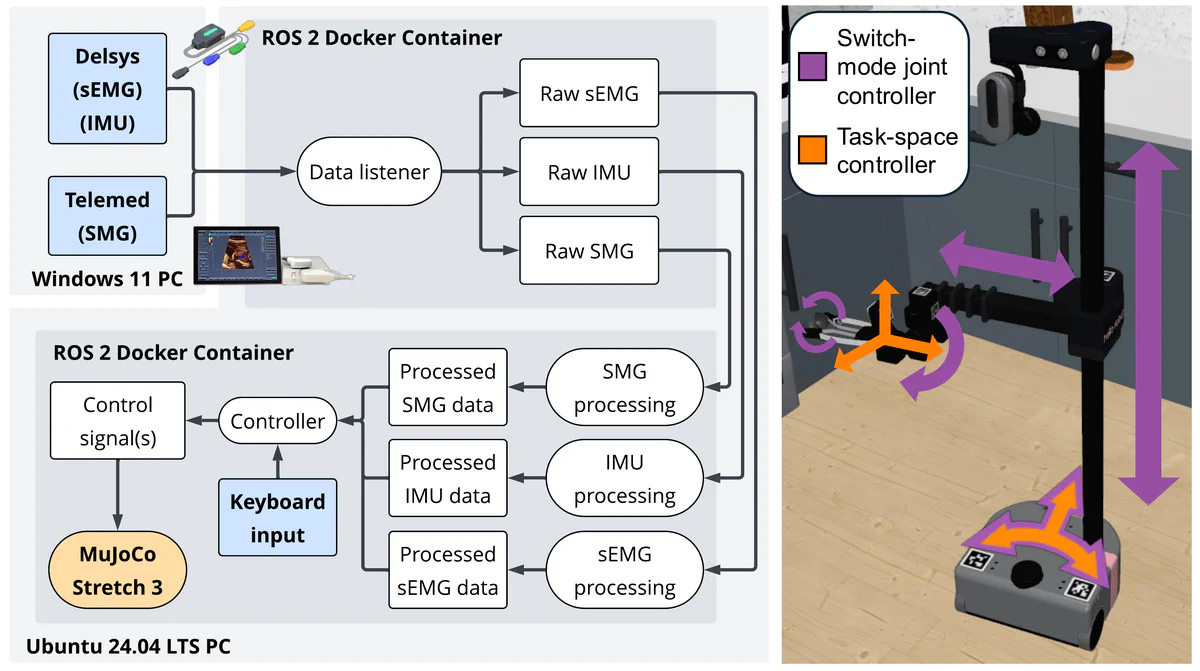
Spinal cord injury (SCI) survivors have diverse residual motor capabilities, illustrating the need for assistive robot interfaces that can flexibly adapt to different user-specific biosignals and control preferences. This work presents a modular ROS 2-based platform for mapping sonomyography, surface electromyography, inertial measurement unit, and keyboard inputs to the degrees of freedom of a simulated Stretch 3 mobile manipulator in MuJoCo. By enabling rapid “plug-and-play” remapping of inputs to robot motions, this platform provides a foundation for developing and evaluating intuitive, dexterous assistive robot control strategies in collaboration with SCI survivors.

Carson J. Wynn
PhD Student, Robotics
My research interests lie in human–robot interaction. I want to model the interaction between human and robot, discover new techniques and technologies, and contribute to the HRI field.
Simon Padgen
PhD Student, Robotics
I am interested in all things robotics, but am especially passionate about its application in the worlds of medicine and robot assistance.
Laura A. Hallock
Assistant Professor of Mechanical Engineering
My research interests include robotic assistance and rehabilitation, neuromusculoskeletal sensing, and human–robot control interfaces.