Toward Drift-Resistant Assistive Device Control via sEMG–SMG Fusion
Abstract
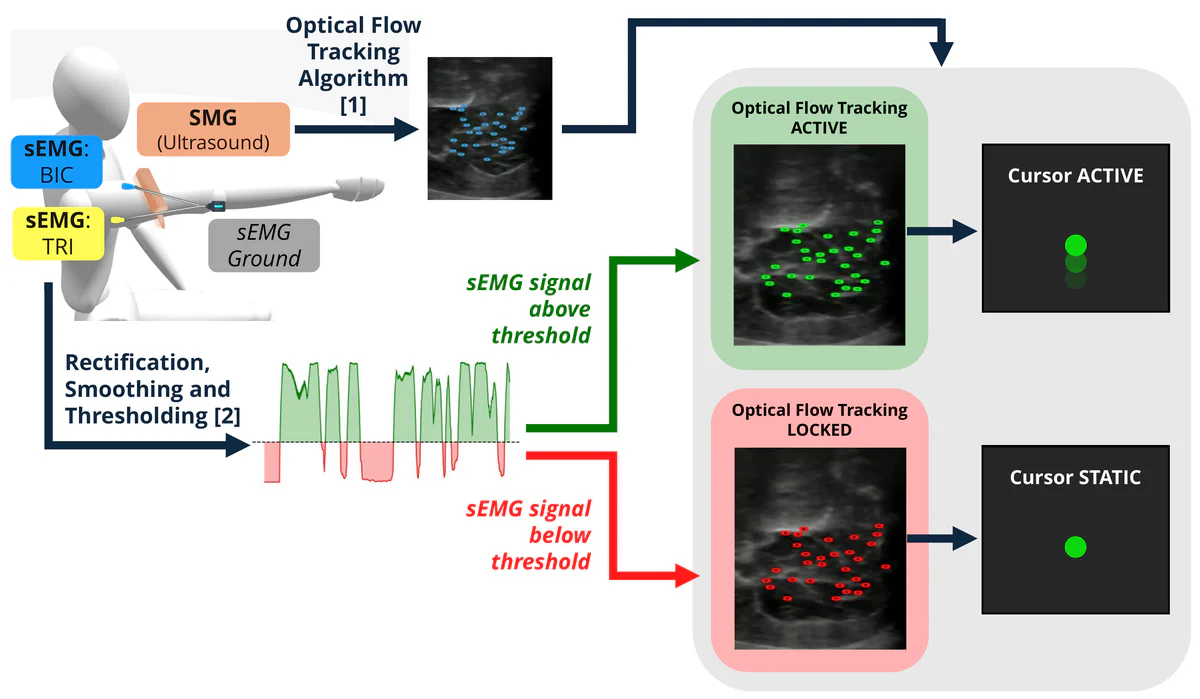
Effective assistive robotic technology requires an effective control interface. Optical-flow-based sonomyography (SMG) can provide continuous control signals for such devices, but may drift over time. This work investigates whether surface electromyography (sEMG) can reduce drift by restricting SMG tracking to periods of muscle activation. Although the combined sEMG–SMG signal reduces noise, our naive threshold-based approach does not improve control performance because tissue deformation can occur without measured sEMG activation. These results motivate improved sensor placement and more advanced fusion methods for hybrid biosensing control.

Gavin Sueltz
BS/MS Student, ME

Maria Herrera
BS/MS Student, ME

Vikram Athithan
Undergraduate, ME

Laura A. Hallock
Assistant Professor of Mechanical Engineering
My research interests include robotic assistance and rehabilitation, neuromusculoskeletal sensing, and human–robot control interfaces.