Continuous 2-DoF SMG Control via Optical Flow Feature Grouping and Principal Component Analysis
Abstract
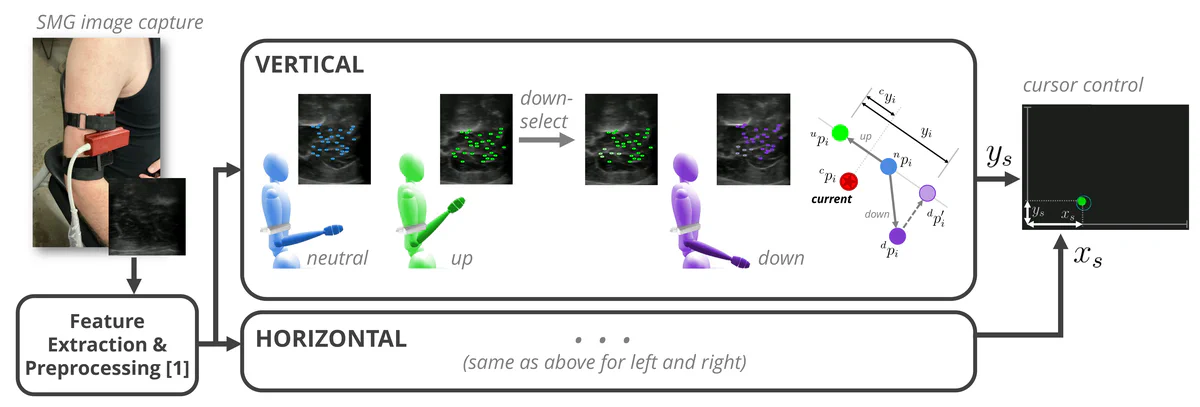
Sonomyography (SMG) enables continuous control of assistive devices by measuring muscle deformation, but achieving multi-degree-of-freedom (DoF) control with minimal sensors remains challenging. Our prior work demonstrated 2-DoF control from a single ultrasound probe using optical flow, but with substantial signal coupling. We propose a modified algorithm that assigns each control signal to subsets of features exhibiting the greatest motion during user-defined movements, aiming to improve independence between DoF. When tested by a single user performing a cursor control task, the method achieved 2-DoF control but exhibited coupling comparable to our prior approach, likely due to overlap between feature groups. This work establishes a platform for exploring improved grouping strategies and alternative feature tracking methods, toward efficient control of high-DoF assistive devices.

Simon Padgen
PhD Student, Robotics
I am interested in all things robotics, but am especially passionate about its application in the worlds of medicine and robot assistance.

Laura A. Hallock
Assistant Professor of Mechanical Engineering
My research interests include robotic assistance and rehabilitation, neuromusculoskeletal sensing, and human–robot control interfaces.